

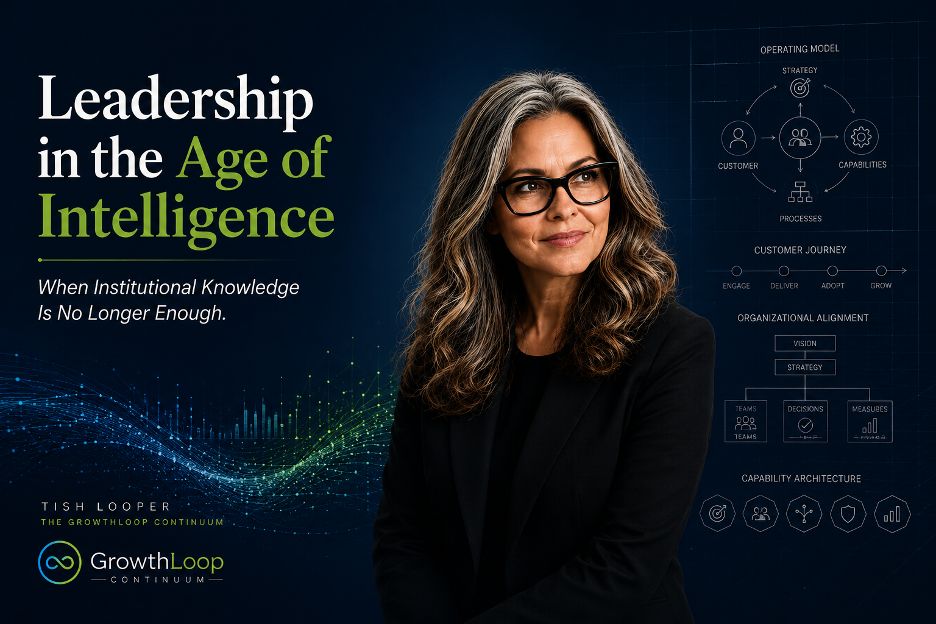
Leadership in the Age of Intelligence

Artificial intelligence is changing more than productivity.
It's changing the source of leadership value.
Over the past several weeks, I've found myself reflecting on three questions—not about technology, growth, or customer success, but about something I believe sits at the center of every successful organization: leadership.
What does AI reveal about leadership?
What does AI change about human value?
What happens when knowledge is no longer the scarce resource?
I don't believe AI created these challenges.
I believe it revealed them.
Technology has a way of exposing what already exists—organizations that don't learn, teams that operate in silos, leaders who confuse information with insight, and companies that optimize today's metrics instead of building tomorrow's capabilities.
For decades, leaders were rewarded for what they knew. Experience meant accumulated knowledge. Expertise meant having answers. Institutional knowledge became one of an organization's greatest competitive advantages. The people who had been there the longest knew the history, understood the market, recognized the unwritten rules, and often became the people others depended on for answers.
But what happens when institutional knowledge is no longer enough?
If AI can retrieve the history, summarize years of documentation, recognize patterns across thousands of interactions, and surface insights in seconds, then the value of experience begins to shift. Experience is no longer defined by what we remember. It is defined by how we interpret, apply, and act on what we know.
Then intelligence became abundant.
So, what becomes the role of leadership in the Age of Intelligence?
Not just artificial intelligence, because AI is only one form of intelligence. Leaders have always relied on Customer Intelligence, Market Intelligence, Organizational Intelligence, and, most importantly, Human Intelligence. Those forms of intelligence don't disappear in the age of AI. They become even more valuable because AI enables us to leverage them faster, recognize patterns sooner, and make more informed decisions.
What is changing is the balance between knowledge and judgment.
Knowledge answers, "What happened?"
Judgment asks, "Given today's reality, what should we do next?"
Leaders have always exercised judgment. What AI changes is the depth, speed, and accessibility of the information that informs that judgment. Rather than replacing leadership, AI expands a leader's ability to recognize patterns, evaluate options, challenge assumptions, and make better-informed decisions. Judgment remains uniquely human. AI simply strengthens the foundation upon which it is exercised.
This naturally leads to another question.
In the Age of Intelligence, are leaders preparing for the future or simply optimizing the present?
Too many organizations remain focused on today's priorities. Quarterly results. Current initiatives. Immediate efficiencies. Yet history has shown that the organizations that thrive are rarely the ones that predict the future perfectly. They are the ones that build the capabilities to adapt when the future arrives.
Leadership has never been about knowing the most.
It has always been about helping organizations become what they need to be next.
As access to intelligence becomes increasingly abundant, judgment, adaptability, and the ability to prepare people for change become the defining capabilities of exceptional leaders.
AI doesn't diminish leadership.
It raises the standard.
Leadership creates clarity when information is abundant. It builds alignment when change accelerates. And it prepares organizations, teams, and individuals to adapt around a shared purpose.
Technology accelerates.
Leadership architects.


Comments